what causes interest rates to rise in the 1980s
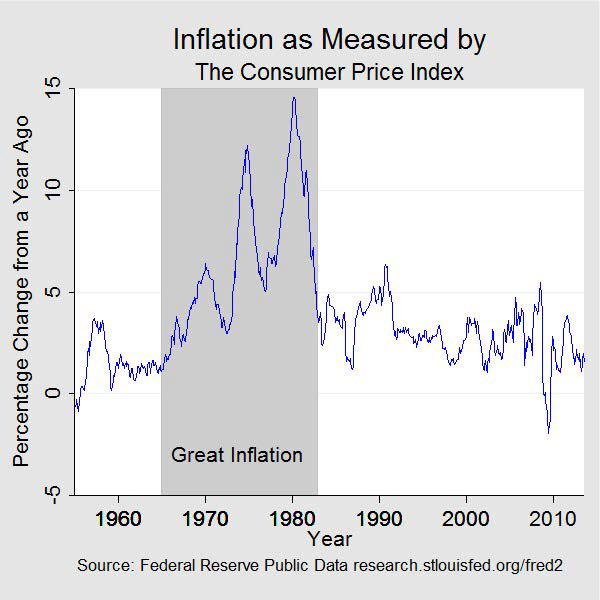
The Bang-up Aggrandizement was the defining macroeconomic menstruation of the second half of the twentieth century. Lasting from 1965 to 1982, it led economists to rethink the policies of the Fed and other central banks.
Close-upwardly of a "Whip Inflation At present" [WIN] push, President Ford's symbol of the fight against inflation. (Photograph: Bettmann/Bettmann/Getty Images)
The Great Inflation was the defining macroeconomic event of the second half of the twentieth century. Over the about two decades it lasted, the global budgetary organization established during Earth War II was abandoned, there were four economic recessions, two astringent free energy shortages, and the unprecedented peacetime implementation of wage and price controls. It was, according to ane prominent economist, "the greatest failure of American macroeconomic policy in the postwar period" (Siegel 1994).
But that failure also brought a transformative change in macroeconomic theory and, ultimately, the rules that today guide the monetary policies of the Federal Reserve and other central banks around the world. If the Great Inflation was a consequence of a corking failure of American macroeconomic policy, its conquest should be counted every bit a triumph.
Forensics of the Groovy Inflation
In 1964, inflation measured a petty more than than ane pct per year. It had been in this vicinity over the preceding half-dozen years. Inflation began ratcheting upward in the mid-1960s and reached more than than 14 percent in 1980. It eventually declined to average simply iii.5 percent in the latter one-half of the 1980s.
While economists debate the relative importance of the factors that motivated and perpetuated inflation for more than a decade, in that location is little debate about its source. The origins of the Great Aggrandizement were policies that allowed for an excessive growth in the supply of money—Federal Reserve policies.
To empathize this episode of especially bad policy, and monetary policy in particular, information technology will be useful to tell the story in three distinct but related parts. This is a forensic investigation of sorts, examining the motive, means, and opportunity for the Bully Inflation to occur.
The Motive: The Phillips Curve and the Pursuit of Full Employment
The kickoff office of the story, the motive underlying the Neat Aggrandizement, dates back to the immediate aftermath of the Great Depression, an before and equally transformative menstruation for macroeconomic theory and policy. At the conclusion of Globe War II, Congress turned its attention to policies it hoped would promote greater economic stability. Most notable among the laws that emerged was the Employment Act of 1946. Among other things, the act declared information technology a responsibleness of the federal government "to promote maximum employment, production, and purchasing power" and provided for greater coordination between fiscal and monetary policies.1 This act is the seminal basis for the Federal Reserve's current dual mandate to "maintain long run growth of the monetary and credit aggregates…so as to promote finer the goals of maximum employment, stable prices and moderate long-term interest rates" (Steelman 2011).
The orthodoxy guiding policy in the mail service-WWII era was Keynesian stabilization policy, motivated in large function by the painful memory of the unprecedented loftier unemployment in the U.s.a. and around the globe during the 1930s. The focal point of these policies was the management of aggregate spending (demand) by way of the spending and taxation policies of the financial authority and the budgetary policies of the central banking concern. The thought that monetary policy can and should be used to manage aggregate spending and stabilize economic activity is still a by and large accepted tenet that guides the policies of the Federal Reserve and other central banks today. But i critical and erroneous assumption to the implementation of stabilization policy of the 1960s and 1970s was that there existed a stable, exploitable relationship between unemployment and inflation. Specifically, it was mostly believed that permanently lower rates of unemployment could be "bought" with modestly higher rates of inflation.
The idea that the "Phillips bend" represented a longer-term trade-off betwixt unemployment, which was very damaging to economic well-being, and inflation, which was sometimes thought of as more than of an inconvenience, was an attractive assumption for policymakers who hoped to forcefully pursue the dictates of the Employment Act.two But the stability of the Phillips curve was a fateful assumption, one that economists Edmund Phelps (1967) and Milton Friedman (1968) warned against. Said Phelps "[I]f the statical 'optimum' is called, it is reasonable to suppose that the participants in product and labour markets volition learn to expect inflation…and that, as a consequence of their rational, anticipatory behaviour, the Phillips Curve will gradually shift upward..." (Phelps 1967; Friedman 1968). In other words, the trade-off between lower unemployment and more than inflation that policymakers may take wanted to pursue would probable be a false bargain, requiring ever higher inflation to maintain.
The Means: The Collapse of Bretton Forest
Chasing the Phillips bend in pursuit of lower unemployment could non take occurred if the policies of the Federal Reserve were well-anchored. And in the 1960s, the US dollar was anchored—albeit very tenuously—to gold through the Bretton Woods agreement. So the story of the Corking Aggrandizement is in part also about the collapse of the Bretton Forest system and the separation of the US dollar from its last link to aureate.
During World State of war II, the world'due south industrial nations agreed to a global monetary system that they hoped would bring greater economical stability and peace by promoting global trade. That system, hashed out by forty-four nations in Bretton Woods, New Hampshire, during July 1944, provided for a fixed rate of commutation betwixt the currencies of the world and the Us dollar, and the United states of america dollar was linked to gold.3
Only the Bretton Forest arrangement had a number of flaws in its implementation, primary among them the attempt to maintain stock-still parity betwixt global currencies that was incompatible with their domestic economic goals. Many nations, it turned out, were pursing monetary policies that promised to march up the Phillips curve for a more favorable unemployment-inflation nexus.
Every bit the globe's reserve currency, the Us dollar had an additional trouble. Equally global trade grew, so as well did the demand for U.S. dollar reserves. For a time, the need for US dollars was satisfied past an increasing residuum of payments shortfall, and foreign cardinal banks accumulated more and more dollar reserves. Eventually, the supply of dollar reserves held away exceeded the US stock of gold, implying that the United States could not maintain consummate convertibility at the existing price of gilt—a fact that would not go unnoticed by foreign governments and currency speculators.
As inflation drifted higher during the latter half of the 1960s, US dollars were increasingly converted to gold, and in the summer of 1971, President Nixon halted the commutation of dollars for gold by foreign central banks. Over the next two years, there was an attempt to salvage the global monetary arrangement through the curt-lived Smithsonian Agreement, just the new arrangement fared no better than Bretton Woods and information technology speedily bankrupt down. The postwar global monetary system was finished.
With the last link to gold severed, near of the world'southward currencies, including the United states of america dollar, were at present completely unanchored. Except during periods of global crisis, this was the first time in history that well-nigh of the monies of the industrialized world were on an irredeemable paper coin standard.
The Opportunity: Fiscal Imbalances, Energy Shortages, and Bad Information
The late 1960s and the early 1970s were a turbulent time for the Usa economy. President Johnson's Great Society legislation brought near major spending programs across a wide array of social initiatives at a time when the US fiscal situation was already beingness strained by the Vietnam State of war. These growing financial imbalances complicated monetary policy.
In order to avoid budgetary policy actions that might interfere with the funding plans of the Treasury, the Federal Reserve followed a practice of conducting "even-keel" policies. In applied terms, this meant the central bank would not implement a alter in policy and would concord interest rates steady during the period betwixt the announcement of a Treasury issue and its sale to the market place. Under ordinary weather condition, Treasury issues were infrequent and the Fed'south fifty-fifty-keel policies didn't significantly interfere with the implementation of monetary policy. But equally debt issues became more prevalent, the Federal Reserve's adherence to the even-keel principle increasingly constrained the conduct of monetary policy (Meltzer 2005).
A more than disruptive strength was the repeated energy crises that increased oil costs and sapped U.S. growth. The first crisis was an Arab oil embargo that began in October 1973 and lasted about v months. During this menstruum, crude oil prices quadrupled to a plateau that held until the Iranian revolution brought a second energy crisis in 1979. The second crisis tripled the cost of oil.
In the 1970s, economists and policymakers began to commonly categorize the rise in amass prices equally different inflation types. "Need-pull" inflation was the direct influence of macroeconomic policy, and monetary policy in particular. It resulted from policies that produced a level of spending in excess of what the economy could produce without pushing the economic system beyond its ordinary productive capacity and pulling more expensive resources into play. But inflation could likewise exist pushed higher from supply disruptions, notably originating in nutrient and energy markets (Gordon 1975).4 This "price-push button" inflation as well got passed through the chain of product into higher retail prices.
From the perspective of the central depository financial institution, the inflation existence caused by the ascension toll of oil was largely beyond the command of monetary policy. Just the rising in unemployment that was occurring in response to the leap in oil prices was not.
Motivated by a mandate to create full employment with little or no anchor for the management of reserves, the Federal Reserve accommodated big and rising financial imbalances and leaned confronting the headwinds produced past free energy costs. These policies accelerated the expansion of the money supply and raised overall prices without reducing unemployment.
Bad data (or at least a bad agreement of the data) as well handicapped policymakers. Looking dorsum at the information policymakers had in hand during the period leading up to and during the Neat Inflation, economist Athanasios Orphanides has shown that the real-time judge of potential output was significantly overstated, and the approximate of the charge per unit of unemployment consequent with full employment was significantly understated. In other words, policymakers were too likely underestimating the inflationary effects of their policies. In fact, the policy path they were on merely wasn't feasible without accelerating inflation (Orphanides 1997; Orphanides 2002).
And to make matters worse yet, the Phillips curve, the stability of which was an important guide to the policy decisions of the Federal Reserve, began to move.
From High Aggrandizement to Inflation Targeting—The Conquest of U.s.a. Aggrandizement
Phelps and Friedman were right. The stable trade-off between inflation and unemployment proved unstable. The power of policymakers to control any "real" variable was ephemeral. This truth included the rate of unemployment, which oscillated around its "natural" rate. The merchandise-off that policymakers hoped to exploit did non exist.
Every bit businesses and households came to appreciate, indeed conceptualize, rise prices, any trade-off betwixt inflation and unemployment became a less favorable exchange until, in fourth dimension, both aggrandizement and unemployment became unacceptably high. This, and then, became the era of "stagflation." In 1964, when this story began, inflation was 1 pct and unemployment was v pct. 10 years later, inflation would be over 12 per centum and unemployment was in a higher place 7 percent. By the summer of 1980, inflation was near 14.5 percent, and unemployment was over 7.5 percent.
Federal Reserve officials were not blind to the inflation that was occurring and were well aware of the dual mandate that required monetary policy to exist calibrated and then that it delivered total employment and price stability. Indeed, the Employment Human action of 1946 was re-codified in 1978 by the Full Employment and Balanced Growth Human activity, more commonly known equally the Humphrey-Hawkins Act after the bill'southward authors. Humphrey-Hawkins explicitly charged the Federal Reserve to pursue total employment and price stability, required that the cardinal bank establish targets for the growth of various budgetary aggregates, and provide a semiannual Budgetary Policy Report to Congress.5Nevertheless, the employment half of the mandate appears to accept had the upper hand when total employment and inflation came into conflict. Every bit Fed Chairman Arthur Burns would later merits, full employment was the first priority in the minds of the public and the government, if not also at the Federal Reserve (Meltzer 2005). Just there was also a clear sense that addressing the inflation problem head-on would accept been too costly to the economy and jobs.
In that location had been a few earlier attempts to control inflation without the costly side upshot of college unemployment. The Nixon administration introduced wage and price controls over iii phases between 1971 and 1974. Those controls only temporarily slowed the rising in prices while exacerbating shortages, particularly for food and energy. The Ford assistants fared no better in its efforts. Later declaring aggrandizement "enemy number i," the president in 1974 introduced the Whip Aggrandizement At present (WIN) program, which consisted of voluntary measures to encourage more thrift. Information technology was a failure.
By the belatedly 1970s, the public had come to wait an inflationary bias to monetary policy. And they were increasingly unhappy with inflation. Survey after survey showed a deteriorating public confidence over the economy and government policy in the latter half of the 1970s. And frequently, inflation was identified as a special evil. Interest rates appeared to be on a secular rise since 1965 and spiked sharply higher withal as the 1970s came to a shut. During this fourth dimension, business investment slowed, productivity faltered, and the nation'south trade rest with the rest of the world worsened. And inflation was widely viewed equally either a significant contributing factor to the economic malaise or its primary basis.
But in one case in the position of having unacceptably high aggrandizement and loftier unemployment, policymakers faced an unhappy dilemma. Fighting high unemployment would almost certainly bulldoze inflation college still, while fighting aggrandizement would merely every bit certainly cause unemployment to spike even higher.
In 1979, Paul Volcker, formerly the president of the Federal Reserve Bank of New York, became chairman of the Federal Reserve Board. When he took office in August, year-over-year inflation was running above 11 percentage, and national joblessness was just a shade nether 6 per centum. By this time, it was generally accepted that reducing inflation required greater control over the growth rate of reserves specifically, and broad money more than more often than not. The Federal Open Market Committee (FOMC) had already begun establishing targets for the monetary aggregates as required by the Humphrey-Hawkins Human action. But it was clear that sentiment was shifting with the new chairman and that stronger measures to command the growth of the money supply were required. In October 1979, the FOMC announced its intention to target reserve growth rather than the fed funds charge per unit as its policy musical instrument.
Fighting inflation was now seen equally necessary to attain both objectives of the dual mandate, fifty-fifty if it temporarily caused a disruption to economical activity and, for a time, a higher charge per unit of joblessness. In early 1980, Volcker said, "[M]y basic philosophy is over time we take no choice but to bargain with the inflationary state of affairs because over time inflation and the unemployment rate go together.… Isn't that the lesson of the 1970s?" (Meltzer 2009, 1034).
Over time, greater control of reserve and coin growth, while less than perfect, produced a desired slowing in inflation. This tighter reserve direction was augmented by the introduction of credit controls in early 1980 and with the Budgetary Control Act. Over the course of 1980, involvement rates spiked, fell briefly, and then spiked again. Lending activity fell, unemployment rose, and the economy entered a cursory recession between Jan and July. Inflation fell but was still high even as the economy recovered in the 2nd half of 1980.
But the Volcker Fed continued to printing the fight confronting high inflation with a combination of higher interest rates and even slower reserve growth. The economic system entered recession over again in July 1981, and this proved to be more severe and protracted, lasting until Nov 1982. Unemployment peaked at nearly 11 percentage, but aggrandizement connected to move lower and by recession'due south end, twelvemonth-over-twelvemonth inflation was back under v percent. In time, as the Fed'southward commitment to low inflation gained brownie, unemployment retreated and the economy entered a menstruation of sustained growth and stability. The Great Inflation was over.
By this time, macroeconomic theory had undergone a transformation, in large part informed past the economic lessons of the era. The important role public expectations play in the coaction betwixt economic policy and economic operation became de rigueur in macroeconomic models. The importance of time-consistent policy choices—policies that exercise non sacrifice longer-term prosperity for brusque-term gains—and policy brownie became widely appreciated equally necessary for expert macroeconomic results.
Today central banks understand that a commitment to price stability is essential for proficient budgetary policy and most, including the Federal Reserve, have adopted specific numerical objectives for inflation. To the extent they are credible, these numerical inflation targets accept reintroduced an anchor to monetary policy. And in so doing, they have enhanced the transparency of monetary policy decisions and reduced uncertainty, now too understood to be necessary antecedents to the achievement of long-term growth and maximum employment.
Bibliography
Friedman, Milton. "The Part of Monetary Policy." American Economic Review 58, no. 1 (March 1968): 1–17.
Gordon, Robert J. "Alternative Responses of Policy to External Supply Shocks." Brookings Papers on Economical Activity half-dozen, no. 1 (1975): 183–206.
Meltzer, Allan H., "Origins of the Great Inflation," Federal Reserve Bank of St. Louis Review 87, no. two, function 2 (March/April 2005): 145-75.
Meltzer, Allan H. A History of the Federal Reserve, Book two, Book 2, 1970-1986. Chicago: University of Chicago Printing, 2009.
Orphanides, Athanasios, "Monetary Policy Rules Based on Real-Time Data," Finance and Economics Discussion Series 1998-03, Federal Reserve Lath, Washington, DC, December 1997.
Orphanides, Athanasios, "Budgetary Policy Rules and the Great Aggrandizement," Finance and Economics Discussion Serial 2002-08, Federal Reserve Board, Washington, DC, January 2002.
Phelps, E.S. "Phillips Curves, Expectations of Inflation and Optimal Unemployment Over Time." Economica 34, no. 135 (August 1967): 254–81.
Phillips, A.West. "The Relation between Unemployment and the Rate of Change of Money Wage Rates in the Britain 1861–1957." Economica 25, no. 100 (1958): 283–99.
Siegel, Jeremy J. Stocks for the Long Run: A Guide to Selecting Markets for Long-Term Growth, 2d ed. New York: McGraw-Hill, 1994.
Steelman, Aaron. "The Federal Reserve'south 'Dual Mandate': The Evolution of an Idea." Federal Reserve Bank of Richmond Economic Brief no. 11-12 (December 2011).
courtneytheigiche42.blogspot.com
Source: https://www.federalreservehistory.org/essays/great-inflation
0 Response to "what causes interest rates to rise in the 1980s"
Post a Comment