How Do You Know When Your Invacare Platinum Xl Is Low

The Keystone Pipeline system has been the subject of controversy for years as environmentalists and others accept fought to prevent construction and expansion of this oil-delivery network. On January 20, 2021, President Joe Biden issued numerous executive orders, including one that aimed to protect public health and the environment past restoring science to tackle the climate crisis. One of this guild'due south tenants revoked the March 2022 permit for the Keystone Xl Pipeline, noting that the pipeline "disserves" the United States, especially in terms of the state's renewed efforts to combat climate change.
This executive social club came in the wake of the United States Supreme Courtroom's 2022 ruling, which saw the justices siding with ecology groups and ruling that the Keystone XL Pipeline (KXL) — a rerouted addition to the existing organisation — would need to undergo a much lengthier and more detailed permitting process before the expansion could occur. At that time, the ruling represented a victory for those who opposed the projection. Now, even with hopes of time to come structure completely dashed, the KXL remains a hotly debated upshot. In fact, its current land is almost every bit fraught as its history.
The History of the Keystone Xl Pipeline
To understand KXL and the tumult surrounding it, it helps to go back to the kickoff: the Keystone Pipeline. Running from the town of Hardisty in Alberta, Canada, through North Dakota, South Dakota, Nebraska, Kansas, Oklahoma, Texas, Missouri and Illinois, the original Keystone Pipeline opened in 2010 with the purpose of delivering Canadian crude oil into the The states where information technology would be refined, stored and distributed. The pipeline is exactly what it sounds like: a network of massive steel and plastic pipes — some of which are upward to 4 anxiety in diameter — through which oil is transported. Various pump stations positioned along the pipeline aid to push the oil through the network, which exists primarily underground.

Aircraft oil this way is much more toll effective than transporting the resource via truck or train — sometimes simply a tertiary of the price of overground methods — and this profitability is ane of the principal reasons oil pipelines are appealing to oil and gas companies. Forbes notes that aircraft oil via the Keystone pipeline versus by rail saves an estimated $50 billion per year. The volume a pipeline tin can transport is some other advantage for oil companies, with hundreds of thousands of (or sometimes over a million) barrels of oil moving through the network on a daily basis. Lastly, shipping oil in pipelines is much faster than moving it by boat, truck or rail. So, the incentives for oil companies and energy users to build and utilize pipelines are clear — but enough of variables exist to make pipelines a less-than-appealing option, as well. The Keystone and KXL developers have had to fence with these disadvantages and challenges since the project's inception.
TransCanada Energy Corporation, an energy-infrastructure programmer, first proposed the idea for the Keystone Pipeline in 2005. In 2007, union members and activists ready to work lobbying the Canadian regime to cake approving of the pipeline, citing concerns about the environment, lack of energy security and dearth of Canadian jobs the Keystone would create — information technology would primarily benefit the U.s.a., transporting oil out of Canada and into the Midwest. Despite this backlash, Canada's National Energy Board approved all construction of the Canadian section of the pipeline, and George Due west. Bush signed a Presidential Permit — which is necessary for a project like this to be built in the United States — that authorized construction and maintenance of the line starting at the U.S.-Canada edge. Structure began, lasting two years after an initial two-twelvemonth flow was spent procuring additional permits.
Before the Keystone Pipeline was fifty-fifty operational, KXL was proposed. In the summer of 2008, while the Keystone's construction was barely getting underway, TransCanada Energy filed a new application for KXL with the National Energy Board, and it was approved right around the same fourth dimension in 2010 that the Keystone Pipeline became operational. Here'southward where the proverbial waters start to get muddy. While a few divide extensions to the Keystone were approved and their construction wrapped up quickly in 2011, developers began getting ambitious with their plans.
Their next motility? To create a separate pipeline with a faster, more straight road from Hardisty, Alberta, to Steele Metropolis, the strategic bespeak in Nebraska where the pipeline extensions to Illinois and refineries along the Gulf Coast begin branching off. This proposed new pipeline, KXL, would be bigger than the original Keystone, carrying near 200,000 more barrels of oil per day and passing through Montana instead of North Dakota. Canada's National Free energy Board approved the KXL in 2010. Its journey for approval in the United States is where much of its controversy begins.
Opposition to KXL started in a very probable identify: with then-President Barack Obama and among diverse environmental and cultural groups. Every bit mentioned, a Presidential Let is necessary for construction of this nature to take place, and President Obama was unwilling to issue i for KXL due in office to recommendations from the Environmental Protection Agency (EPA). While reviewing project proposals and the scope of KXL, the EPA determined that the Land Section's prepared studies and assessments of the potential environmental impact of the new pipeline merited the lowest feasibility rating possible because of their insufficient information.

The environmental touch on study should've included extensive details about greenhouse gas emissions, oil-spill response plans and other issues — simply it didn't. Because the project would cross an international border the State Section was required to set these reports, and the EPA'southward refusal to recommend KXL to the White Business firm meant the Land Section would demand to have months to create newer, more than detailed reports that incorporated the requested information. President Obama cited additional reasons for opposing the project as well, stating that KXL would not lower the price of gas or create long-term jobs for the The states.
The EPA'due south initial conclusion about the insufficiency of the Land Department'south reports was issued in the summer of 2010, only a few months subsequently Canada's National Energy Board approved KXL. Immediately, environmental groups and activists — such as the Sierra Club, National Resources Defense Council, National Wildlife Federation and Pipeline Safety Trust, a prophylactic-focused charity that envisions a world with naught environment-compromising pipeline incidents — set out to protestation the new pipeline. Framing "the determination as i that [would] define Obama's legacy on climate change," environmentalists argued that the project would increment U.Southward. dependence on fossil fuels and, in doing so, mean the state was tacitly accepting the environmental damage that could potentially occur equally a result. Merely information technology's important to understand the unlike forms that damage can accept to fully see why environmental groups oppose the projection to this twenty-four hour period.
Drilling for oil has a vast number of potentially harmful effects on the environment — like creating air and water pollution and destroying fauna habitats — and and so do the construction and functioning of a pipeline. In the process of building a pipeline, frail ecosystems may exist destroyed to make style for the piping — an upshot that environmental groups similar Friends of the Earth oftentimes cite as a reason to prevent construction of KXL. Nebraska'southward Sandhills region is 1 such area. This ancient ecoregion is the largest sand dune formation in the United States and inside it lies the Ogallala Aquifer, an underground h2o source that'south the largest in North America, providing drinking h2o to more than than 2 million people
It's also important to note that the oil coming out of the Alberta sites in Hardisty isn't the same as conventional crude oil; it's tar sands oil, which is much more toxic than conventional crude. Extraction of tar sands oil, butt for butt, emits up to 3 times more than global warming pollution than crude oil, and tar sands pipelines have a spill rate that's 3 times the national average for pipelines carrying conventional crude oil in the Midwest. This toxicity, combined with the higher potential for pollution and catastrophic spills that could destroy communities and ecoregions, is primarily why environmentalists justify opposition to KXL.
Information technology's also why a diverseness of other groups, including surface area farmers and Native American tribes, continue to oppose the new pipeline to this day. Landowners, just particularly farmers, stand to lose their livelihoods if a spill occurs, and many would be subject field to eminent domain, forced to sell their properties to the government to make style for KXL's construction or allow disruptive easements through their state. Native American tribes accept like concerns over the fact that the new pipeline would disturb culturally important areas and present a number of other issues. The Rosebud Sioux Tribe and the Fort Belknap Indian Community, of South Dakota and Montana, respectively, are especially concerned about the ways KXL could negatively impact their areas' unique water systems, infringe on their line-fishing and hunting rights and violate treaties.
The U.South. government initially had until the end of 2011 to decide whether or not to allow the pipeline. Thousands of people gathered at the White Business firm toward the cease of that year to protest KXL in large demonstrations, including making a homo concatenation around the property. In January of 2012, President Obama rejected the awarding to build KXL — but the boxing was far from over.
Legal Battles Over the Pipeline Ignite
Before he left function, President Obama officially ordered all work relating to KXL to stop after vetoing several bills that would've allowed pipeline structure to move forward, noting that the projection "would undercut U.S. leadership on reducing carbon emissions." This cancellation lasted throughout the remainder of his presidency, following the State Department'southward official rejection of the new pipeline. KXL was a non-starter, and it appeared this would stay the status quo — until Donald Trump was elected.

Less than a week after taking office in 2017, Trump signed an executive social club allowing the permitting and eventual construction of KXL and the Dakota Access Pipeline, another famously contested project, to resume. In a presidential memorandum, he likewise invited TransCanada to resubmit an awarding for KXL. Merely ii months later in March of 2017, a permit for the projection was issued.
In response, a variety of groups rose up, springing into action to file lawsuits against Trump'southward conclusion. Legal challenges to KXL's construction have been ongoing in the years since the project was canonical and correspond opposition from a diverse array of objectors.
Who? Rosebud Sioux Tribe, the Fort Belknap Indian Customs and the Native American Rights Fund (NARF) vs. the Trump Administration
When? Initially filed in September 2022 in the U.S. District Courtroom of Montana; ongoing
Why? In an official statement, the NARF outlined the reasons for the suit: "There was no analysis of trust obligations, no analysis of treaty rights, no analysis of the potential affect on hunting and fishing rights, no analysis of potential impacts on the Rosebud Sioux Tribe'due south unique h2o system, no analysis of the potential impact of spills on tribal citizens, and no analysis of the potential affect on cultural sites in the path of the pipeline, which is in violation of the National Environmental Policy Act, and the National Celebrated Preservation Deed." Prior to Trump's and the State Department's greenlighting of the projection, no new analysis was performed in regards to how the pipeline would impact reservation lands, including sacred, bequeathed and historic sites. The plaintiffs likewise assert that the decision violates tribal sovereignty and ignores treaties, federal laws and tribal laws.
Who? Northern Plains Resource Council, Sierra Club, Middle for Biological Multifariousness, Bold Alliance, Friends of the Earth and Natural Resource Defense force Council vs. Army Corps of Engineers
When? Initially filed in summer of 2022 in the U.Southward. District Court of Montana; ongoing
Why? The environmental groups in this case contend that the Army Corps of Engineers' approval of TransCanada's proposal was illegal considering information technology failed to examine the project's potential for spills and other types of environmental impairment. Co-ordinate to the Sierra Club, "The groups maintain that this blessing violates the National Environmental Policy Deed, Endangered Species Human action, and Clean Water Act, and urged the court to require the Corps to conduct additional environmental review of the effects of pipelines like Keystone 40 on local waterways, lands, wildlife, communities and the climate." These groups are asserting that the Land Department and Trump administration are violating numerous federal laws in attempting to push the KXL permitting process through quickly and without acceptable research on the potential impacts of construction.
Rulings and Ruddy Tape: The Supreme Court'due south 2022 Decision
Various rulings accept taken place following litigation confronting KXL. For example, in November of 2018, U.S. District Court Judge Brian Morris plant that numerous environmental reviews were insufficient and outdated and that they violated the National Environmental Policy Act, the Endangered Species Deed and the Administrative Procedure Human activity. The approximate ordered the U.S. authorities to perform an updated ecology review and blocked construction of KXL in the interim.

This followed Judge Morris' July 2022 ruling that the Country Department needed to carry a full environmental review of KXL in Nebraska — a result of a dissever lawsuit filed on behalf of the Northern Plains Resources Council, Assuming Alliance, Center for Biological Diversity, Friends of the Earth, Natural Resources Defence Quango and Sierra Club. Fifty-fifty in Apr of 2020, Judge Morris nullified h2o-crossing permits that had been issued for KXL in Montana, citing a potential violation of the Endangered Species Human action.
Similar rulings have resulted from a number of lawsuits filed confronting the U.S. government, many of which argue virtually what plaintiffs believe were rushed, insufficiently researched decisions on the part of the Trump assistants and the Country Section. One of the latest rulings in this spate of lawsuits canceled the Nationwide Let 12, which provided coating potency to and fast-tracked piece of work on a number of pipelines that cross bodies of h2o. In May of this year, a federal judge ruled that these new pipelines needed to exist subject area to much lengthier and more comprehensive environmental review processes than what was initially planned in order to receive permits.
Just a few months afterward July half-dozen, 2020, the Supreme Court ruled that many of the other pipelines involved in the May ruling would be immune to go on — but KXL would not. Why? Information technology however required a more rigorous environmental review. Environmental groups viewed this as a temporary victory for the at-take a chance communities and creature species that live along the proposed pipeline route. Moreover, information technology sent a potent message to developers hoping to disregard environmental concerns.
Dismantling KXL: President Biden'southward Executive Order
Equally mentioned above, President Biden signed an executive order that revoked the KXL pipeline permit granted by the Trump Administration. In fact, Biden'due south Inauguration Day executive society will seemingly end the $8 billion project altogether. "Killing 10,000 jobs and taking $2.2 billion in payroll out of workers' pockets is not what Americans demand or want correct at present," said Andy Blackness, president and CEO of the Association of Oil PipeLines (via NPR).
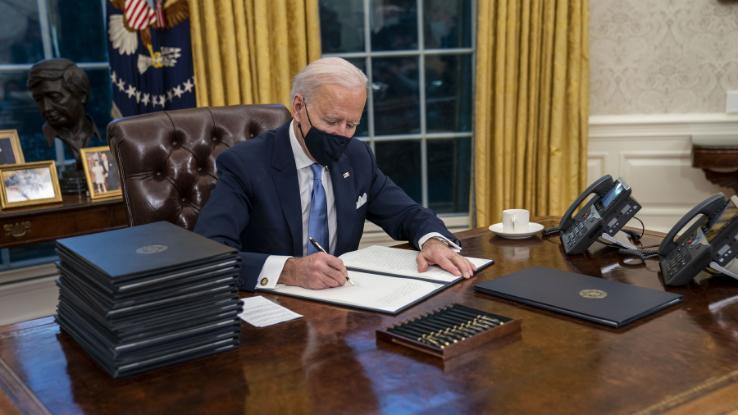
However, a January 20 statement from TC Energy indicated that President Biden'southward gild "would directly lead to the layoff of thousands of spousal relationship workers." And so, where's that higher number coming from? Co-ordinate to a fact check past the Austin American-Statesman, "10,400 estimated positions would exist needed for seasonal construction piece of work lasting 4 to eight-month periods." Temporary jobs are however jobs, merely information technology seems the Biden Assistants has a program to offset this loss.
"At home, nosotros will gainsay the [climate] crisis with an ambitious plan to build back meliorate, designed to both reduce harmful emissions and create practiced clean-energy jobs," the executive lodge states. "The U.s. must be in a position to do vigorous climate leadership in order to reach a meaning increment in global climate action and put the world on a sustainable climate pathway. Leaving the Keystone Xl pipeline permit in place would not exist consistent with [Biden's] Administration's economic and climate imperatives."
In the wake of the executive club, environmental groups have praised President Biden'south decision — as well every bit his dedication to rejoining the Paris climate agreement. Needless to say, the withdrawal of the KXL permit illustrates President Biden's firm and immediate commitment to regulating the oil industry; investing in clean energy; and taking on the climate crisis.
courtneytheigiche42.blogspot.com
Source: https://www.reference.com/business-finance/why-is-keystone-xl-pipeline-disputed?utm_content=params%3Ao%3D740005%26ad%3DdirN%26qo%3DserpIndex
0 Response to "How Do You Know When Your Invacare Platinum Xl Is Low"
Post a Comment